
Quick answer: Cold-pressed oil is extracted by mechanical pressing with minimal or no added heat and goes through minimal processing. Refined oil starts as crude oil, which may be extracted mechanically, with solvents, or both, and is then purified in several steps to give a more neutral taste, lighter colour and longer shelf life. Neither is automatically “good” or “bad”. They differ in flavour, processing, smoke point and shelf life, and the right choice depends on the specific oil and how you cook.
Key takeaways
- Cold-pressed oil generally retains more of the seed’s natural flavour, colour and aroma.
- Refined oil is usually more neutral, and refined versions of many oils generally have higher smoke points than their unrefined counterparts.
- Cold-pressed oils often have a shorter shelf life and usually cost more.
- The oil’s fatty-acid profile depends mainly on the source seed, not only on the method.
- All oils are calorie-dense, so quantity matters whichever you choose.
If you’ve compared labels in the oil aisle, you’ve probably seen “cold pressed”, “kachi ghani”, “wood pressed” and “refined” side by side. This guide explains what each term means, how the oils differ, and how to choose for your kitchen.
What Is Cold-Pressed Oil?
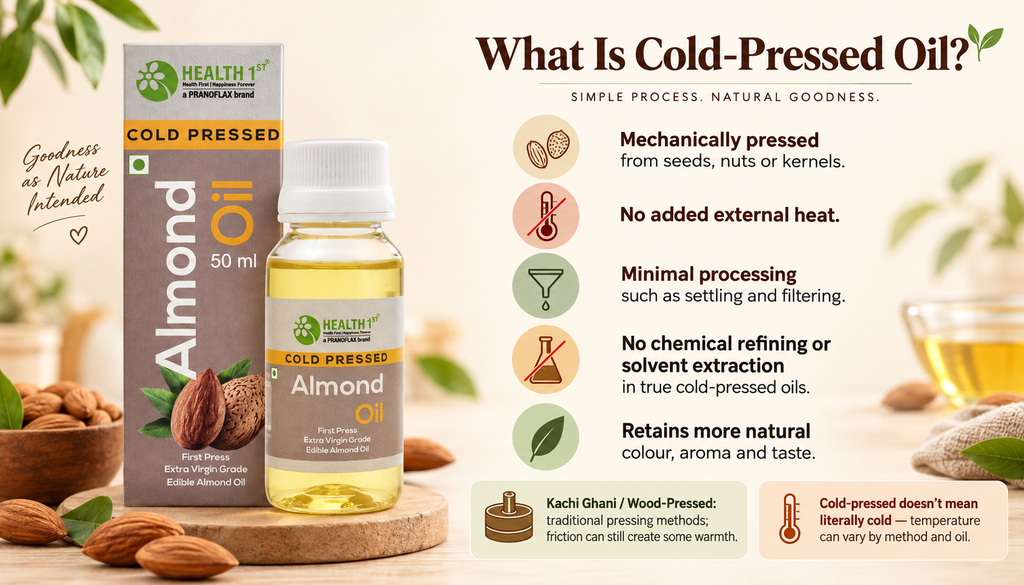
Cold-pressed oil is made by pressing seeds, nuts or kernels mechanically, without applying external heat. The oil is then usually purified only with simple physical steps, such as settling and filtering. It doesn’t go through the multi-step refining used for refined oils, and true cold-pressed oils are extracted without chemical solvents.
Because the processing is minimal, the oil generally keeps its natural colour, aroma and taste. Cold-pressed groundnut oil smells of groundnuts, cold-pressed sesame oil smells of sesame, and cold-pressed mustard oil is pungent.
In India you may also see kachi ghani or wood-pressed (lakdi ghani) oils. These are traditional pressing methods. Friction during pressing can raise the temperature, so check whether a brand states how it controls extraction temperature.
A note on “cold”: Pressing isn’t literally cold. It just avoids added heat, and the process still generates some warmth. Extraction temperatures vary by method and oil, and brands define “cold” differently, so look for a brand that states its process and temperature rather than assuming one fixed limit.
What Is Refined Oil?
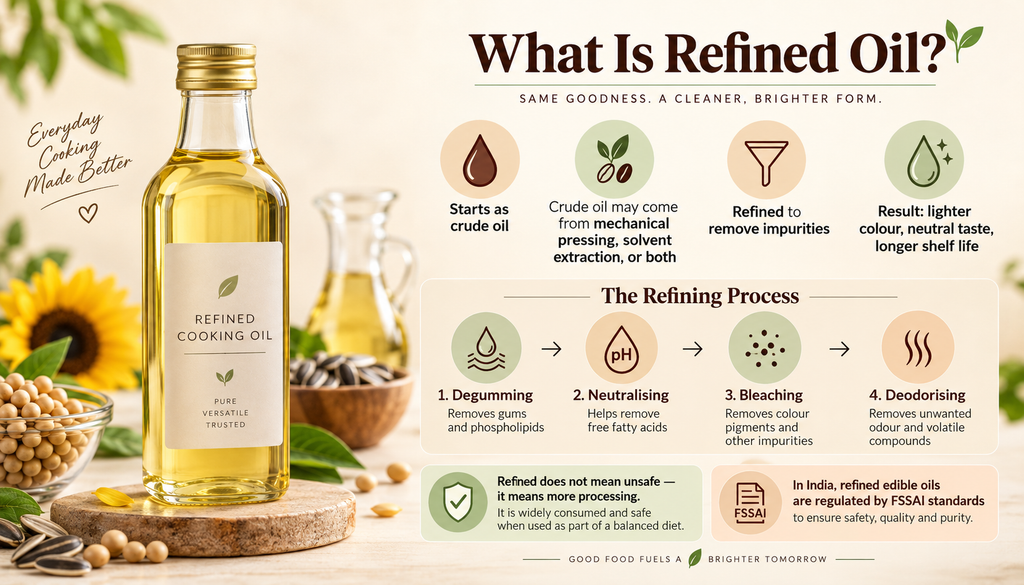
Refined oil starts as crude oil. The crude oil may be extracted by mechanical pressing, by solvent extraction (for example with hexane), or by a combination. Solvent extraction is common for some oils but not universal. The crude oil is then refined to remove impurities. A typical refining process includes:
- Degumming: removes gums and phospholipids.
- Neutralising: removes free fatty acids.
- Bleaching: lightens the colour.
- Deodorising: removes strong smells and flavours, usually with high heat.
The result is usually a light-coloured, neutral-tasting oil with a longer shelf life. Refined does not mean unsafe. In India, refined edible oils are regulated by FSSAI standards, which include limits for residual hexane in solvent-extracted oils. Refined simply means more processing.
Cold-Pressed vs Refined Oil: Comparison Table
| Feature | Cold-Pressed Oil | Refined Oil |
| Extraction | Mechanical pressing with minimal heat | Mechanical and/or solvent extraction may be used |
| Processing | Minimal, usually settling/filtering | Degumming, neutralising, bleaching, deodorising |
| Flavour and aroma | More natural seed flavour | More neutral |
| Colour | Often deeper/natural | Usually lighter |
| Bioactive compounds | Often better retained | Some may be reduced during refining |
| Smoke point | Depends on the oil; often lower than the refined version | Often higher than the unrefined version |
| Shelf life | Often shorter | Often longer |
| Price | Usually higher | Often lower |
| Best use | Depends on the specific oil and cooking temperature | Often suited to high-heat cooking and neutral-flavour uses |
Is Cold-Pressed Oil Healthier Than Refined Oil?
The honest answer is that it depends, and there is no strong evidence that one method is healthier overall for everyone.
Where cold-pressed oil may have an edge:
- It often retains more of the seed’s natural compounds, such as vitamin E and other bioactive compounds, although retention varies by oil and processing.
- It avoids chemical solvents and the multi-step refining process.
- Its flavour makes it easy to use in smaller amounts.
Where refined oil has advantages:
- Refining removes impurities and free fatty acids, which can improve shelf life and stability.
- Refined versions of many oils tolerate higher cooking temperatures.
What matters just as much:
- The type of oil. Fatty-acid balance depends mostly on the source. A cold-pressed oil high in saturated fat will still be high in saturated fat.
- How much you use. Oils provide roughly 120 calories per tablespoon, whichever type you choose.
- How you cook. Overheating oil, or reusing it repeatedly for deep frying, is a bigger concern than the extraction method.
In short, cold-pressed oil isn’t a health cure, and refined oil isn’t automatically harmful. Choose based on taste, cooking method and quality.
Which Oil Is Better for Cooking?
The best use depends on the specific oil and its smoke point, which is the temperature at which an oil starts to smoke and break down. Smoke point varies with the type of oil, its free fatty acid level and how it has been refined.
As a general guide:
- Refined versions of many oils have higher smoke points than their unrefined counterparts, so they are often chosen for deep frying and other high-heat cooking.
- Some cold-pressed oils handle moderate cooking well, depending on the oil, while others are better suited to dressings, chutneys, dips and tadka at moderate temperatures.
- If a brand gives cooking guidance for a particular oil, follow it.
Whichever oil you use, don’t heat it until it smokes, and avoid reusing frying oil repeatedly. Many households keep more than one oil, using a cold-pressed oil where the flavour matters and a higher-heat oil for occasional frying.
How to Choose a Genuine Cold-Pressed Oil
The term “cold pressed” isn’t always used consistently on labels, so it helps to check a few things:
- Ingredients: A single-ingredient oil should list only the oil itself, for example “cold pressed groundnut oil”.
- FSSAI licence number: This should appear on the label.
- Process details: Look for brands that explain their extraction method and temperature.
- Natural colour and smell: Many cold-pressed oils have a noticeable natural smell and colour, though this varies by oil.
- Batch and date information: Check the packaging date and shelf life.
- Packaging: Dark glass, tin or well-sealed containers help protect the oil from light.
- Realistic claims: Be cautious about products that promise to cure or prevent disease.
How to Store Cold-Pressed Oil
Cold-pressed oils are less processed, so they can turn rancid sooner than refined oils:
- Keep the bottle tightly closed, away from heat, light and moisture.
- Store in a cool, dry cupboard, not next to the stove.
- Use within the shelf life on the label, and buy in quantities you’ll finish in a reasonable time.
- If the oil smells sharp, bitter or “off”, don’t use it.
Frequently Asked Questions
What is the main difference between cold-pressed and refined oil?
Cold-pressed oil is extracted by pressing with minimal heat and is minimally processed. Refined oil is purified through several steps, such as degumming, neutralising, bleaching and deodorising, to give a more neutral taste, lighter colour and longer shelf life.
Is cold-pressed oil healthier than refined oil?
Cold-pressed oil often retains more natural bioactive compounds and avoids the multi-step refining process, but there’s no strong evidence it is healthier for everyone. The type of oil, how much you use and how you cook matter just as much.
Is kachi ghani oil the same as cold-pressed oil?
Both refer to traditional or mechanical pressing methods, but the terms are not identical. Kachi ghani refers to the traditional wooden or stone press, and friction can raise the temperature, so check the brand’s process details.
Can I use cold-pressed oil for frying?
It depends on the specific oil and its smoke point. Refined versions of many oils generally have higher smoke points than unrefined ones, so they are often chosen for deep frying. For any oil, follow the brand’s cooking guidance and avoid heating it until it smokes.
Why is cold-pressed oil more expensive?
Pressing without solvents or added heat usually yields less oil from the same amount of seed, and the oil often has a shorter shelf life, which raises the cost.
Does cold-pressed oil expire faster?
Often, because it is less processed. Store it in a cool, dark place and follow the shelf life on the label.
Final Thoughts
Cold-pressed and refined oils are made differently and suit different uses. Cold-pressed oil generally retains more of the seed’s natural flavour and some bioactive compounds, while refined oil is usually more neutral and more stable at higher cooking temperatures. Instead of asking which is “best”, choose the right oil for each job, read labels carefully, keep portions moderate and store your oil well.
Looking for cold-pressed options? Explore our Cold Pressed Oils collection.
Disclaimer: This article is for general information only and is not medical advice. Consult a doctor or qualified dietitian before making major changes to your diet, especially if you have a health condition or take medication.
0 Comments